

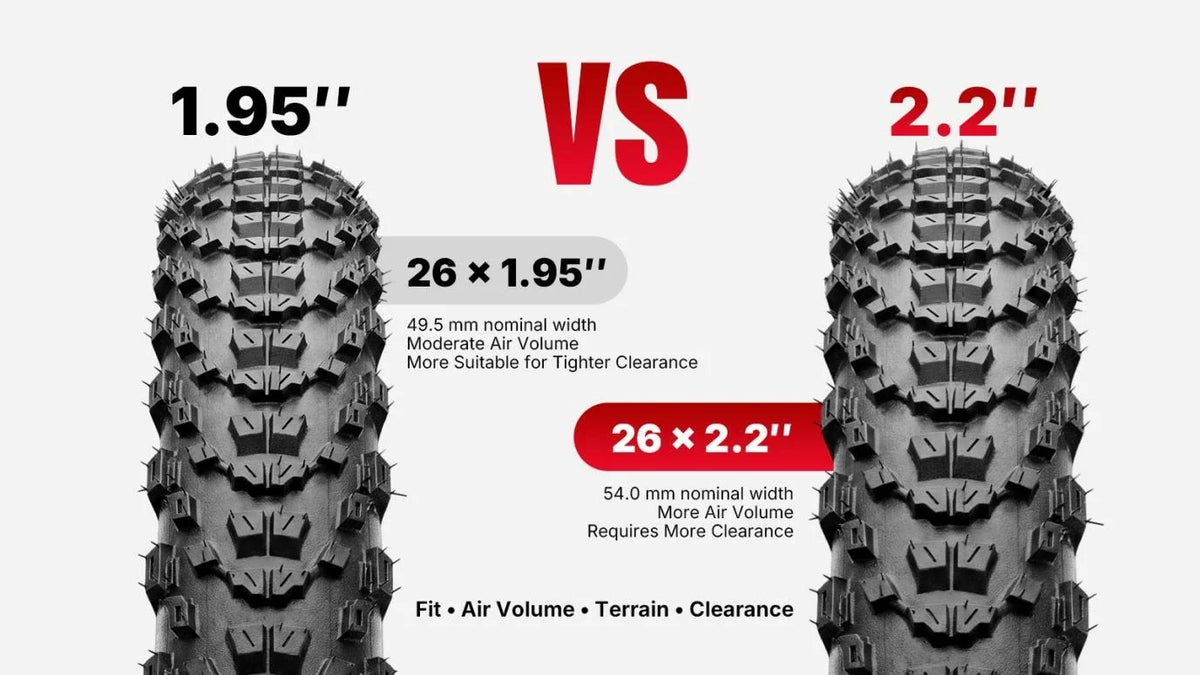
A 26×1.95 bike tire is narrower than a 26×2.125 tire, and both can fit the same 559 mm wheel in some setups if your rim and bike clearance allow it. The 2.125 inch option offers more air volume for rough ground, while the 1.95 inch size can suit tighter frames and firmer routes.
What Do 26×1.95 and 26×2.125 Tire Sizes Mean?
26×1.95 and 26×2.125 describe tires with a nominal 26 inch outer diameter and different nominal widths. A 26×1.95 tire has a nominal width of about 49.5 mm, while a 26×2.125 tire has a nominal width of about 54.0 mm.
For most decimal-marked 26-inch mountain and cruiser tires, the vital compatibility measurement is a 559 mm bead-seat diameter. A tire marketed as 26×1.95 may carry an ETRTO marking around 50-559, while a 26×2.125 tire may be marked around 54-559. Always use the actual sidewall marking as the final reference.
| Tire Size | Nominal Width | Approximate ETRTO Size | Typical Use |
|---|---|---|---|
| 26×1.95 | 49.5 mm | 50-559 | Pavement, hardpack, moderate trails |
| 26×2.125 | 54.0 mm | 54-559 | Rough paths, gravel, loose terrain |

Use the sidewall as your final size reference. An ETRTO label such as 50-559 identifies a tire with a nominal 50 mm width and a 559 mm bead-seat diameter. A 54-559 tire uses the same 559 mm rim diameter, so it can mount on the same wheel when the rim-width range supports it. The first number helps you compare tire volume and frame clearance, while the second number confirms the tire-to-rim diameter match.
How Much Difference Does 0.175 Inch Make?

A 0.175 inch difference equals about 4.4 mm in nominal tire width. Actual tire shape and clearance vary with the rim, casing, pressure, and frame alignment, so measure the mounted tire near the chainstays, fork legs, fenders, and brake hardware. Even a small width change can matter where clearance is tight or mud builds up.
A 26×2.125 tire has slightly more air volume than a comparable 1.95 inch tire. At an appropriate pressure, the larger volume can soften bumps and help the tire follow uneven surfaces. A 26×1.95 bike tire may feel more direct on smooth pavement or packed dirt.
Width alone does not determine rolling speed. Tire pressure, tread pattern, casing construction, rubber compound, and road surface also affect rolling resistance.
Will 26×1.95 and 26×2.125 Tires Fit the Same Bike?

26×1.95 and 26×2.125 tires can fit the same bike if both use a 559 mm bead-seat diameter, match the rim, and clear every nearby bike part. A 2.125 inch tire needs more room than a 1.95 inch tire at the fork crown, seatstays, chainstays, brakes, and fenders.
Follow these checks before changing tire width:
- Read the sidewall on your current tire and locate the ETRTO size.
- Confirm that the new tire also ends in -559.
- Review the tire maker’s approved rim-width range.
- Mount and inflate the tire within its printed pressure range.
- Check the widest point of the inflated tire around the fork, frame, brake parts, and fenders.
- Spin the wheel and inspect for rubbing before riding.
Catalog measurements are nominal. Rim internal width can alter the tire’s inflated profile, and shoulder knobs can occupy more space than a smooth-tread tire with the same stated width.
Choose the Width That Fits Both Bike and Terrain

A 26×1.95 tire may be a practical choice when clearance is limited, you mainly ride pavement or hardpack, or you prefer to stay close to the bike's original tire size. JUCEO 26×1.95 mountain bike tires offer tread options for firm routes and mixed terrain.
Choose a bike tire 26×2.125 if your bike has enough clearance and your rides include broken pavement, gravel, roots, or loose dirt. The added volume can support a more comfortable setup on uneven terrain. JUCEO 26×2.125 bicycle tires suit riders who need more volume for mixed and uneven surfaces.
| Riding Priority | 26×1.95 Tire | 26×2.125 Tire |
|---|---|---|
| Daily pavement riding | A practical choice for paved routes and hardpack | Works well when the bike has generous clearance |
| Mixed paths and gravel | Offers responsive handling with moderate volume | Adds volume for broken pavement and loose gravel |
| Roots and uneven trails | Suits light trail use with a suitable tread | Supports a calmer ride across rougher surfaces |
| Tight frame or fenders | Fits more easily where space is limited | Requires a careful clearance check |
| Load and comfort | Supports general riding at an appropriate pressure | Provides additional air volume for comfort-focused setups |
Use the following order for a confident choice:
- Correct 559 mm bead-seat diameter
- Compatible rim-width range
- Adequate clearance around the fully inflated tire
- Tread pattern suited to your main riding surface
- Pressure range suitable for rider weight, cargo, and terrain
Find Your Best 26-Inch Tire
Measure your current tire, rim, and tightest clearance point before ordering. If your bike has limited clearance or you mainly ride firm surfaces, a 26×1.95 tire may be a practical choice. If your bike has enough clearance and you ride rougher or looser surfaces, a 26×2.125 tire can provide additional air volume. Check the sidewall markings first, then choose a tread pattern that fits where you ride most.
FAQ about 26×1.95 and 26×2.125 Bike Tire
Q1: Will a 26×1.95 Tube Fit a 26×2.125 Tire?
Yes, if the tube’s printed size range includes both widths and its valve fits your rim. Many butyl tubes cover nearby widths, such as 1.75 to 2.125 inches. Check the tube package or tube sidewall before installation. A tube used beyond its approved range can stretch too far and become more vulnerable to damage.
Q2: Does a 2.125 Inch Tire Roll Much Slower?
Not necessarily. Compare tires on the same bike, rim, route, and pressure range for a useful result. A 2.125 inch tire can carry more air, while tire weight and tread design also shape acceleration and road feel. Use the pressure range printed on each tire, then adjust gradually for your surface and rider load.
Q3: Can I Mix 1.95 Front and 2.125 Rear Tires?
Yes, provided both tires fit their rims and have enough clearance. A 1.95 inch front tire with a 2.125 inch rear tire can work for general riding. Check rear-frame clearance carefully, especially around the chainstays, seatstays, rear brake, and fenders, since the rear tire often has less available room.
Q4: Why Does a 1.95 Inch Tire Measure Wider Than Listed?
A 1.95 inch tire can measure wider than its label because printed widths are nominal. For a reliable clearance check, inflate the tire, seat both beads evenly, and measure the widest casing or tread point with a ruler or caliper. Record that measurement before fitting fenders or choosing a wider replacement tire.


Leave a comment
This site is protected by hCaptcha and the hCaptcha Privacy Policy and Terms of Service apply.